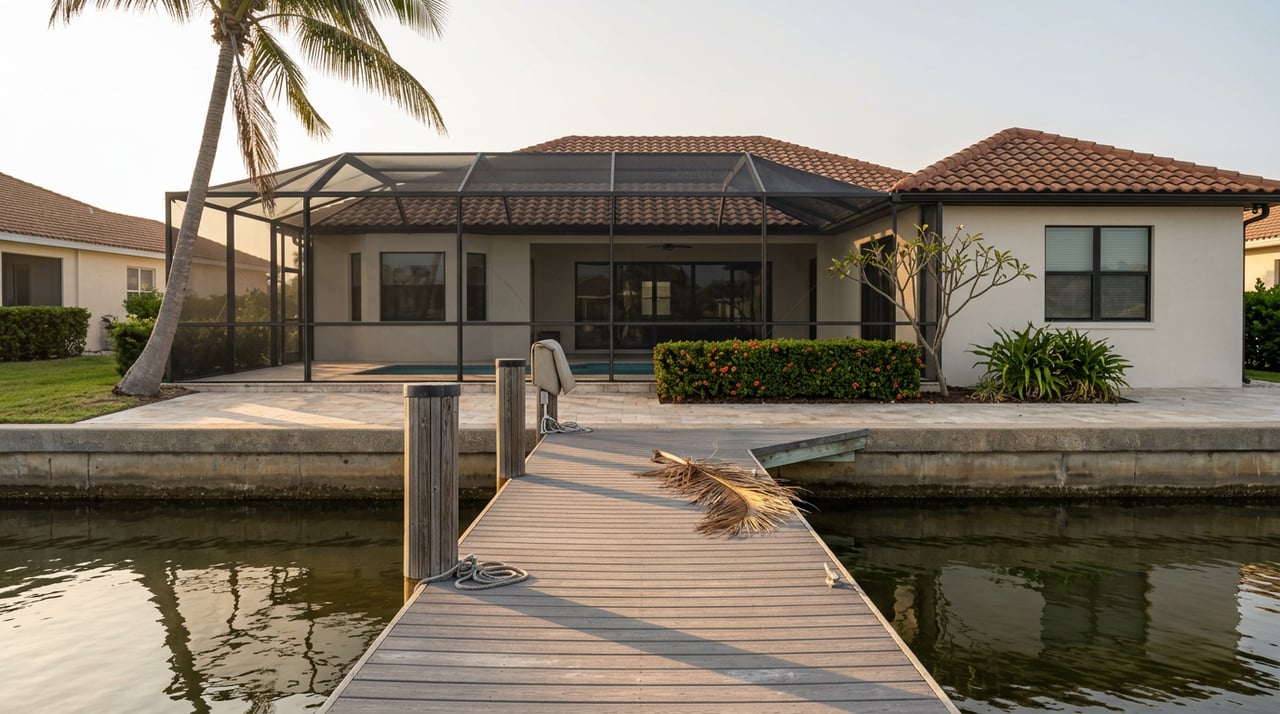
Three days before closing on a Gulf-front property, a buyer opens an email and finds an estoppel certificate with a number nobody mentioned during showings: a $17,000 special assessment for seawall repairs. The listing agent didn't lie. The disclosure forms were in order. The assessment simply hadn't been voted on yet when the home went under contract, and on a barrier island where infrastructure ages on its own schedule, that gap between contract and closing is where deals get renegotiated or walk away entirely.
Casey Key sells itself on elevation. Ask anyone who has spent time on the eight-mile strip of sand between Sarasota and Venice and they'll tell you the ground here sits higher than on the neighboring keys, a quiet advantage locals mention almost in passing. It's true. But elevation and infrastructure are two different conversations, and buyers who confuse them are the ones who end up recalculating their offer at the closing table instead of during due diligence.
The elevation advantage isn't the whole story
Casey Key's ground elevations run higher than most neighboring barrier islands, which matters for flood risk and helps explain why the island has avoided some of the erosion pressure seen elsewhere on the Gulf Coast. It's a real structural advantage, and it's part of why the island has stayed low-density with no high-rises across its roughly 400 residences.
What elevation doesn't tell you is how old the seawall is, whether the dock was ever permitted, or when the last board meeting approved a special assessment for shoreline repair. Those are separate systems with separate paper trails, and a property can sit on excellent high ground while still carrying a seawall that's due for six figures of work. Treating "the elevation is good here" as a stand-in for "the infrastructure is fine" is the first assumption that costs buyers money later in the process.
What the flood map actually governs
Most of Casey Key falls inside FEMA Special Flood Hazard Areas, split mainly between Zone AE and the more expensive Zone VE, which applies to coastal areas exposed to wave action. Two homes on the same road can carry different flood insurance costs depending on which zone line they fall on and how their elevation certificate reads relative to base flood elevation.
Before writing an offer on a Casey Key property, a buyer's checklist should include:
- The current Elevation Certificate, not an old one from a prior owner
- Actual flood and wind insurance quotes from at least two carriers, not estimates
- Confirmation of whether an existing NFIP flood policy is assumable and at what premium
- A marine contractor's inspection of the seawall, pilings, dock, and boat lift
- Permit history for the dock, since many older docks on the island were never permitted
Skipping any one of these doesn't just create risk. It creates a timeline problem, because each item can surface information that changes the offer.
The seawall math nobody puts in the listing photos
Seawall and dock repairs on Casey Key commonly run $50,000 to $250,000 or more depending on length and condition, and a straightforward 100-foot seawall replacement alone can land in the $50,000 to $100,000 range. Roof replacements on the island's larger custom homes can exceed $50,000, and full window upgrades on Gulf-front properties can push past $100,000 once saltwater exposure and custom sizing are factored in.
| Repair category | Typical cost range |
|---|---|
| Seawall or dock replacement | $50,000 – $250,000+ |
| 100-foot seawall replacement | $50,000 – $100,000+ |
| Roof replacement, large home | $50,000+ |
| Window upgrades, Gulf-front home | $50,000 – $100,000+ |
These aren't hypothetical maintenance line items. They're the kind of number that shows up in an inspection report or an estoppel certificate after a buyer is already emotionally and financially committed to a property. Sarasota County requires permits for most structural work over $1,500 on the island, and repairs that accumulate over time can trigger FEMA's 50 percent rule, which forces a home into full code compliance once cumulative improvements cross that threshold relative to the structure's value. A seawall repair that seemed contained can become a bigger project once that line is crossed.
Why $3 million homes take three times longer to reach contract
In Q1 2026, the median time to contract for single-family homes across Sarasota County sat at 54 days. In the $3 million to $4.999 million segment, the same measure was 156 days, nearly three times longer.
The easy explanation is that luxury buyers take their time. The more useful explanation is that this price tier is exactly where the due diligence chain gets longest. A buyer at this level isn't just negotiating price. They're waiting on insurance quotes that take weeks to return, scheduling a marine contractor to inspect a seawall that might need a structural engineer's follow-up, and requesting HOA financials that reveal whether a special assessment is already brewing. Each step can send the deal back to the negotiating table.
On a barrier island, the contract date is the start of the real work, not the finish line.
This is why patience isn't optional at this price point. It's built into how the deal has to move.
The estoppel gap
Florida Statute 720 governs how homeowners associations disclose financial obligations, and it requires that information to be available to buyers. In practice, many of the costliest surprises on Casey Key don't surface until the estoppel certificate is issued, sometimes literally days before closing, because that's when a pending vote on a special assessment becomes official record rather than a rumor at a board meeting.
The sequence that protects a buyer looks like this:
- Request the full HOA financials and reserve study as soon as an offer is accepted, not after
- Ask directly whether any special assessment is pending a vote, even if it hasn't been finalized
- Request the estoppel certificate early rather than waiting for the standard closing timeline
- Have a marine contractor inspect the seawall and dock independently of the seller's disclosure
- Confirm insurance quotes are based on the actual property, not a generic coastal estimate
Buyers who run this sequence in order rarely get surprised. Buyers who skip ahead to writing an offer before doing this homework are the ones who end up back at the negotiating table with a seller three days before closing, trying to split a cost nobody budgeted for.
What a Casey Key title bill actually looks like
Florida's title insurance rates are set by the state, not negotiated between buyer and seller: $5.75 per $1,000 for the first $100,000 of coverage, then $5.00 per $1,000 up to $1 million. On a $1 million Casey Key home, that math produces an owner's title insurance premium of $5,575, calculated on the full purchase price rather than the loan amount. Buyers financing part of their purchase sometimes see a lender's estimate based on the loan figure and assume that's the whole bill, only to find the actual premium is higher once the full purchase price is used. Waterfront and private-road properties on the island can also require additional title endorsements, adding a few hundred dollars more to closing costs.
None of these numbers are secret. They're published rates and public statutes. The problem isn't access to the information. It's timing. A buyer who asks for a full title quote, HOA financials, and a seawall inspection before making an offer controls the timeline. A buyer who asks after going under contract is negotiating from a weaker position with a closing date already on the calendar.
FAQ
Does Casey Key's higher elevation mean lower insurance costs? Elevation can help with flood risk and premiums tied to base flood elevation, but it doesn't change whether a seawall is old, a dock was permitted, or an HOA has a pending special assessment. Insurance quotes still need to be pulled property by property.
How early should a buyer request the estoppel certificate? As soon as an offer is accepted. Waiting for the standard timeline often means the certificate arrives close to closing, leaving little time to renegotiate if it reveals a pending assessment.
Is a dock automatically permitted just because it's already there? No. Many older docks on Casey Key were built before current permitting requirements and were never brought into compliance. Permit history should be verified independently rather than assumed from the dock's existing condition.
If you're evaluating a property on Casey Key and want a clear read on what the seawall, the flood zone, and the HOA paperwork actually mean for your offer, Keith Curcio can walk through the specific due diligence sequence before you're under contract, not after. Let's Connect.