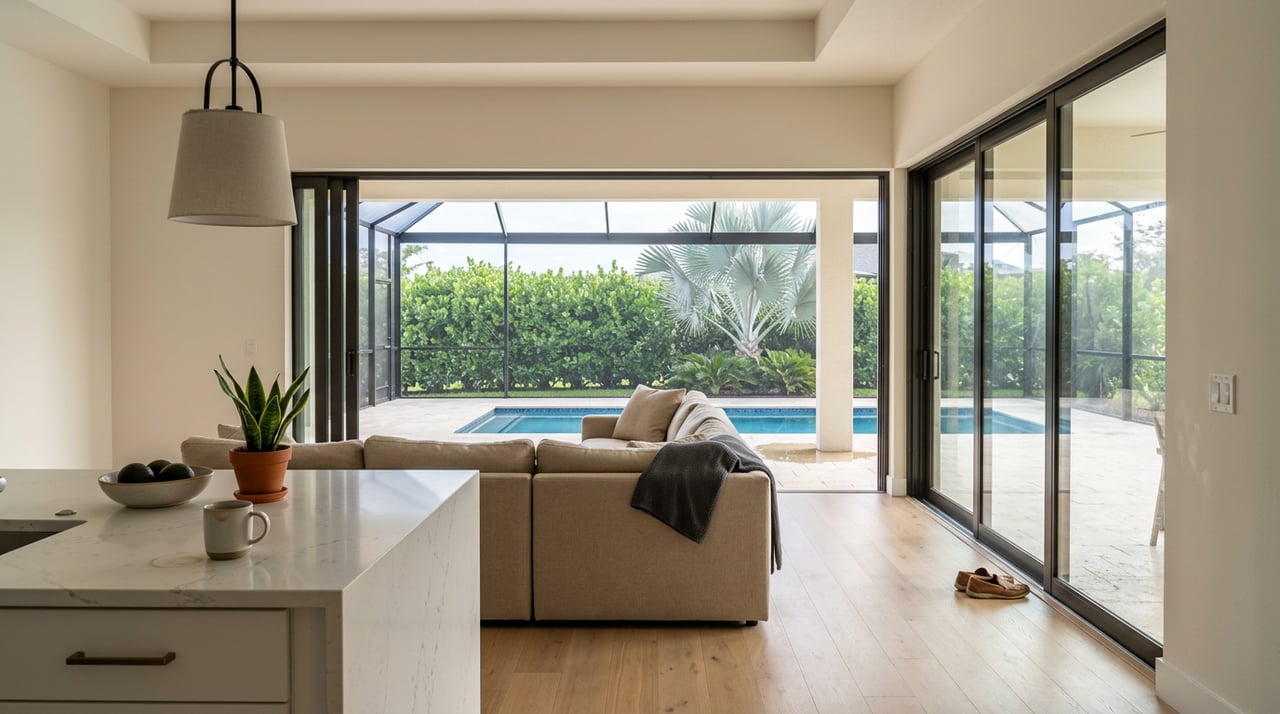
Picture two listings that both hit the portal at $650,000. One sits in an established village near Country Club East. The other is a new build in Waterside or Azario. On the search results page they look interchangeable. On a monthly cash-flow statement, they are not the same house.
The gap between them isn't the mortgage. It's a line most out-of-state buyers don't read until the estoppel comes back during title review: the non-ad valorem CDD assessment on the Manatee County tax bill. That single line, driven by when the village's infrastructure bonds were issued, can move the true cost of ownership by three to five hundred dollars a month between two homes at the same list price.
The side-by-side that the portal doesn't show you
| Line item | Home A: established village | Home B: newer bond village |
|---|---|---|
| List price | $650,000 | $650,000 |
| Estimated property tax (16–20 mills before exemptions) | ~$10,400–$13,000/yr | ~$10,400–$13,000/yr |
| Annual CDD assessment (debt service + O&M) | ~$600–$1,200/yr | ~$3,500–$5,000+/yr |
| Village HOA + master association | ~$150–$300/mo | ~$300–$600/mo |
| Approx. monthly delta from CDD + HOA | baseline | +$300 to $500/mo |
The property tax line is a wash. The mortgage math is a wash. Everything that separates these two homes lives in the assessments and dues.
Why the same list price buys two different monthly bills
A Community Development District is a public special district created under Florida Statutes, Chapter 190, with the authority to issue tax-exempt municipal bonds and levy non-ad valorem assessments against benefited properties. In Lakewood Ranch, several CDDs and the larger Lakewood Ranch Stewardship District finance the roads, drainage, landscaping, and amenities that make each village function. The assessment on your tax bill has two parts: debt service repaying the original bonds, and operations and maintenance covering ongoing upkeep.
Debt service is where the age of the village matters. Bonds are typically repaid over fifteen to thirty years. Newer villages such as Waterside, Azario, and Woodlands issued bonds recently, at current interest rates, so their debt-service assessments sit at the upper end of the range. Older villages have watched bonds amortize down. Two homes at the same square footage and the same list price can carry very different district bills because their infrastructure was financed at different times, at different rates, and is now at different points in its payoff schedule.
The O&M portion moves the other direction. In brand-new phases, developers sometimes subsidize early operations, so O&M starts low and rises as amenities open and staffing grows. In older villages, O&M has generally climbed with the community's operating budget while debt service has fallen. The two lines cross paths at different points depending on the village.
What the zone-by-zone medians are hiding
The 2026 pricing spread across Lakewood Ranch is the widest it has been in years, and the CDD story is a big part of why the zones look the way they do.
- Northwest sector, roughly $495,000 median at about $264 per square foot in early 2026. Older village stock, generally lower CDD debt service.
- Southeast growth corridor (Azario, Esplanade, Park East), roughly $554,000 median at $259 per square foot. Newer construction from builders like Taylor Morrison, Lennar, and Neal Communities, with active bond debt on most parcels.
- Established core (Country Club East, The Lake Club and surrounding neighborhoods), roughly $750,000 median at $318 per square foot. Amortized debt on much of the housing stock.
- Waterside, roughly $850,000 median at $352 per square foot. The newest infrastructure, the freshest bonds, the highest recurring assessments — and the amenity access at Waterside Place, the 36-acre lakefront town center that buyers are paying to be near.
Two of those medians look close on paper. Southeast at $554K and Northwest at $495K sit in the same relocation search filter. But the Southeast home is more likely to carry $3,000+ in annual CDD, while the Northwest home may carry a fraction of that. Sort your search results by monthly carrying cost and the map rearranges itself.
The Amber Creek outlier
There is one active village that breaks the pattern entirely. Amber Creek was financed differently and carries no CDD assessment at all. For an entry-level buyer looking in the $300,000s, that is roughly a thousand dollars a year that never leaves the account. It also comes with fewer resort-style amenities than the newer bond-heavy villages, which is exactly the trade the CDD structure is designed to price. This is the clearest live example of the mechanism: no bonds financed, no assessment collected, lower monthly cost, fewer district-funded amenities. Every other village sits somewhere on that spectrum.
The verification workflow before you write an offer
Most of the friction in a Lakewood Ranch deal comes from buyers assuming there is one "Lakewood Ranch CDD" and one "HOA fee." There isn't. Different villages sit inside different districts, and phases inside a single village can pay different amounts. Here is the sequence I use before an offer goes out:
- Pull the current Manatee County tax bill for the exact parcel at the Manatee County Tax Collector site. Read the non-ad valorem section. Note the district name and the total assessment.
- Separate debt service from O&M. If both lines show up, capture each. Debt service is roughly fixed until bonds are paid off or prepaid. O&M is set annually and can move up or down with the district's budget.
- Request the district's adopted budget and, if a payoff is on the table, an official payoff demand letter from the district manager. Start this early in the inspection period so nothing delays closing.
- Confirm the HOA dues in writing through the estoppel, not the listing sheet. Village HOA fees across Lakewood Ranch range from under $100 a month to more than $600, with typical single-family villages landing between $200 and $300. Bundled maintenance villages sit higher.
- Ask your lender how they will treat the assessment. Some servicers escrow CDD amounts that appear on the tax bill; some don't. It changes your monthly payment either way.
If a listing agent can't produce the last full tax bill and the current district O&M budget within a day or two, that is information about the transaction, not just the paperwork.
Where this bites during the deal
The pattern I see most often is a buyer who ran the numbers on list price, taxes, and HOA, then discovered a $3,200 annual CDD line during title review. Two things can go wrong at that point. The debt-to-income ratio on the loan file tightens, and the lender may re-underwrite. Or the buyer stays qualified but suddenly owns a monthly payment two or three hundred dollars higher than the one they budgeted around.
Neither has to happen. Both are avoidable in the first forty-eight hours of an offer if the assessment is pulled from the parcel record, not inferred from the village name.
FAQ
Do CDD fees ever go away? The debt-service portion ends when the bonds are paid off, typically fifteen to thirty years after issuance, or earlier if the homeowner prepays. O&M continues for as long as the district maintains the infrastructure.
Is the CDD included in the HOA fee? No. The CDD assessment is a public, non-ad valorem line on the county property tax bill. The HOA is a private association billed separately. Many Lakewood Ranch villages have both.
Can I prepay the CDD debt at closing? Sometimes. It depends on the bond documents. Ask the district manager for a payoff demand letter early. Whether prepaying makes financial sense depends on your holding period and the interest rate on the underlying bonds versus what you'd otherwise do with the cash.
If you're comparing villages in Lakewood Ranch and want the actual monthly cost for a specific short list rather than the portal median, Keith Curcio will pull the tax bills, district budgets, and HOA estoppels for each address before you write an offer. Let's connect.